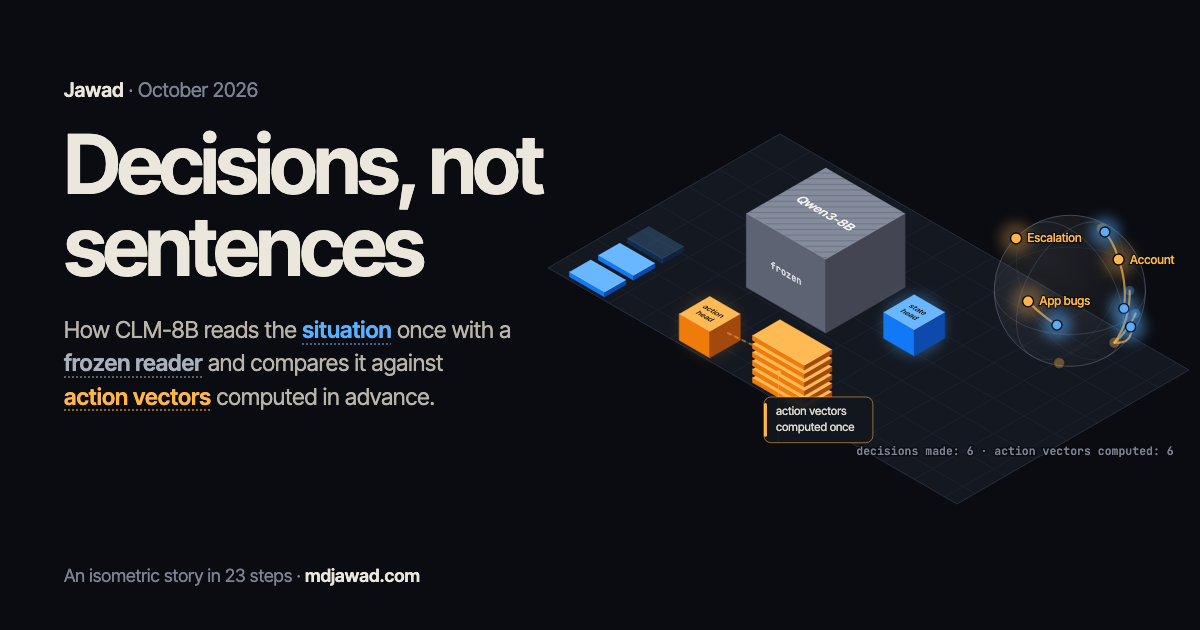
Contrastive Language Models turn a decision into a lookup. CLM-8B, released by researchers at Stanford and NVIDIA in September 2026, never generates text: a frozen Qwen3-8B reads the situation once, a small state head maps that reading into a 512-dimensional space, and the answer is whichever of a set of action vectors, embedded once before any question arrives, lies closest to it. Because the options are computed in advance and reused, the cost of a decision barely depends on how many options there are, which is the property the rest of the design follows from.
This post is a companion to a standalone explainer built as a sequence of 23 isometric scenes rather than a page of figures. Each step is a single idea, the scene changes as you scroll or press the arrow keys, and the coloured words in the text refer to objects in the scene, so hovering one lights up the thing it names. Two hands-on labs at the end let you train the two heads with real gradients and build a small decision model of your own in the browser.
What the story covers
The first act starts from the authors’ own demo, a clone of Chrome’s dinosaur game in which every frame is a text request with three options, and compares the three ways of answering it: a generative model that writes the answer, a judge that reads the situation together with each option, and a lookup that compares precomputed vectors. The second act traces the lineage of the trick, which is older than it looks. A softmax over a set too large to enumerate was replaced by a handful of sampled negatives in DSSM and word2vec in October 2013, named InfoNCE in 2018, made practical for search by Sentence-BERT in 2019 and scaled by CLIP in 2021, whose own paper describes its text tower as a network that writes the weights of a classifier.
The middle acts open the machine. They show why a cosine score is a sum of agreements, why the frozen reader is about 870 times the size of each trainable head, why those heads are needed at all (raw Qwen3-8B embeddings rank William Shakespeare third as the author of Romeo and Juliet, while CLM-8B ranks him first), and how bidirectional InfoNCE, temperature and hard negatives shape the space during training. The cache is treated as an accounting exercise: a judge reads every option for every decision, while CLM reads the menu once and pays only for each new state, which on one RTX 4090 still costs about 28 milliseconds because the 8B reader has to read it.
Where it breaks
The final acts are about limits, and they are where the primary sources changed the story most. A softmax probability is relative to the menu, so adding a synonym of the winning option halves its probability while leaving every other ratio exactly unchanged. A state vector has to be fixed before any option is seen, which is a plausible reason CLM trailed Jev on plain sentiment classification in an independent test by Sebastian Raschka (82.90% against 96.47% on IMDb). The dinosaur demo also needs its fine print: both models survived every run with the same score, but that tie is guaranteed when neither dies, a physics planner writes “Safe” and “Unsafe” into every option’s text, CLM agreed with the planner’s best move 65.8% of the time against Jev’s 98.7%, and the safety layer intervened 4,883 times for CLM and 28 times for Jev across five runs.
The practical resolution is the one search engines reached years ago: retrieve with the cheap model and re-rank the shortlist with the careful one. Every factual claim in the story was checked against the CLM blog, repository and checkpoint, the TypeSafe launch post and the original papers, and every number on screen is labelled as measured by the authors, measured independently, computed from the explainer’s toy model, or schematic.